Balanced Normal Pressure Before Downside Resolution
In this case study, Rubin reads balanced normal upside motion at a high value state before Grace's 90% downside candidate resolves into lower-field delivery.
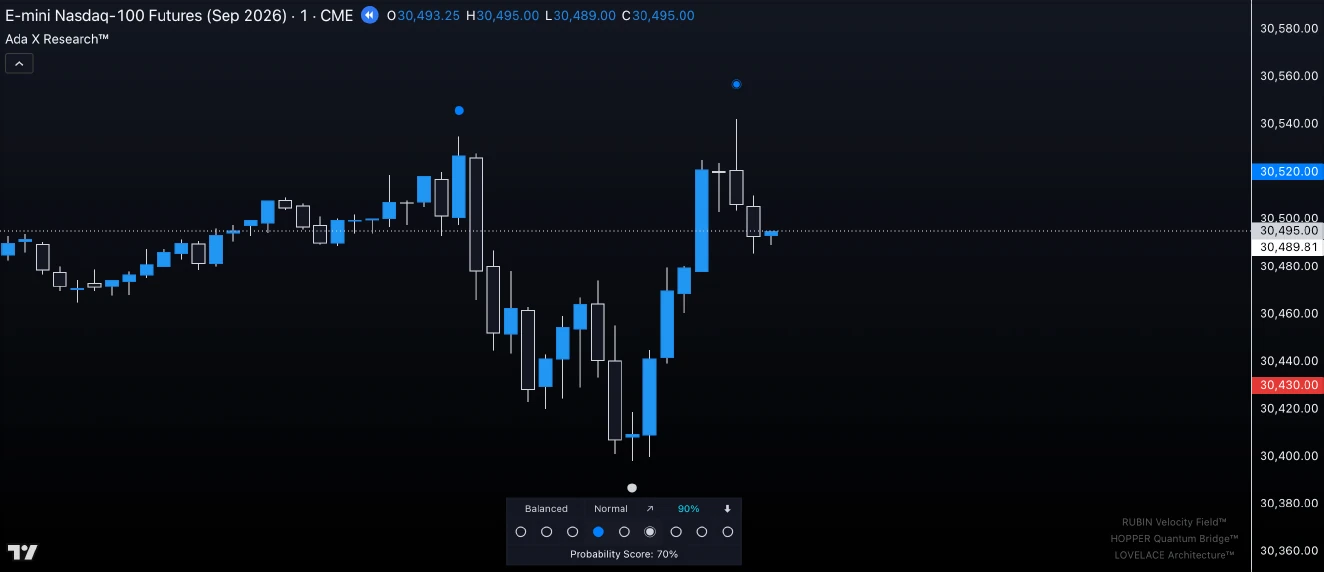
The Dashboard Before Resolution
Case 9 starts from the opposite side of the auction. Rubin shows participation as balanced while motion remains normal to the upside. Price has already matured into a high state according to the footprint logic, so the dashboard is not treating the visible upside as automatically fresh continuation.
Grace finds a potential downside candidate and rates it at 90%. This is the core research condition: the live chart still shows normal upside motion, but the layered system is beginning to study whether the high-state auction is ready to resolve lower.
Balanced Does Not Mean Neutral
The balanced label can look quiet, but in Rubin it still carries information. Balanced participation means the system is not seeing a clean absorbed or one-sided condition. The important detail is how that balanced state interacts with normal upside velocity and the high-state price location.
When Grace adds a 90% downside attack candidate, the note becomes less about a generic reversal and more about layered agreement. Rubin provides the motion and state context, while Grace contributes the directional candidate. The before-frame is useful because those elements appear before the full downside delivery is obvious.
How The Market Resolved
The resolution screenshot shows sufficient downside delivery. Motion slows into drift after the move, and Grace rotates to a 90% upside attack read. That rotation is part of the research value because it marks a change in the next candidate once the original high-state pressure has already played out.
Price also travels to a low value state. The case therefore captures a complete state transition: high state with downside candidate, delivery into the lower field, then drift and a new upside candidate. Rubin's contribution is preserving each stage instead of flattening the entire sequence into one directional call.
Screenshot Sequence
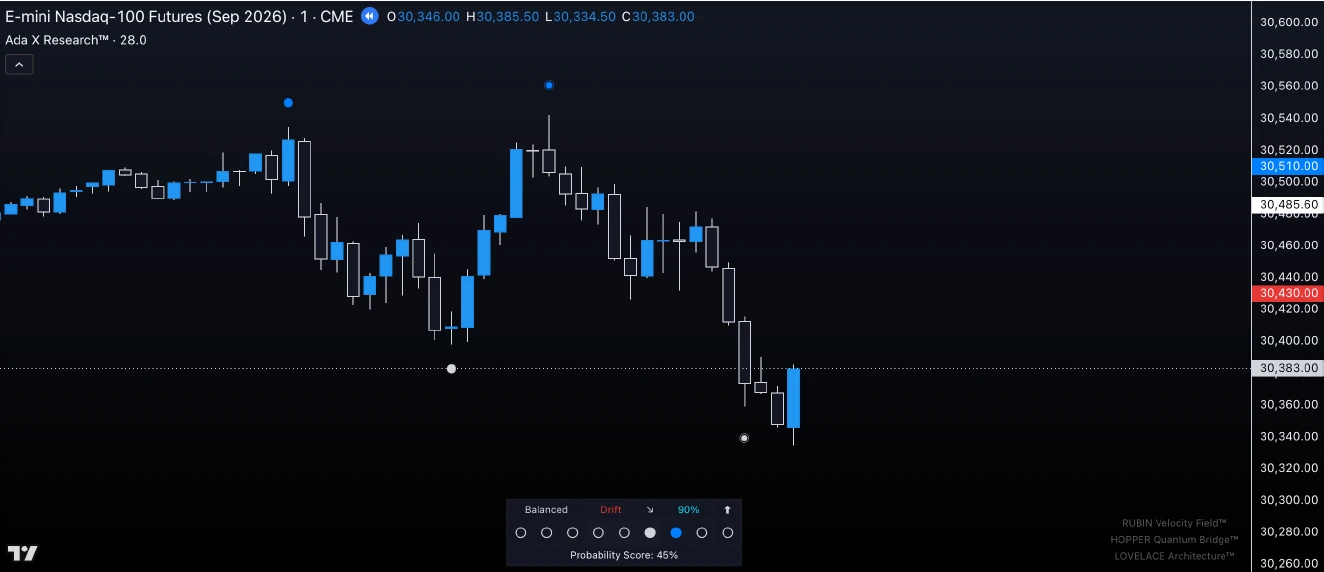
Study the next state with Ada X Research.
Disclaimer: Ada X Research is for educational and research purposes only. Nothing shared is financial advice, investment advice, or a trading signal. Trading involves risk, and users are responsible for their own decisions.
Request access