Built for
Precision.
Not Emotion.
A quantitative trading research environment for Nasdaq futures day trading. Specifically designed quant models which analyze market structure, probability transitions, auction participation, order flow dynamics, motion quality and sophisticated market data— to turn uncertainty into structured probability.

What is Ada X?
Ada X Research is a quantitative trading research environment for Nasdaq futures traders. The framework combines Ada · Lovelace Architecture for market structure, Grace · Hopper Quantum Bridge for probability transition, Rubin · Velocity Field for motion quality, and Emmy · Noether Superposition for uncertainty collapse and participation intent.
Most traders see noise. Ada studies when noise begins to reveal order.
Code as Architecture
Named after Ada Lovelace. The system treats code as structure — a framework for translating live market behavior into a disciplined probability environment.
Beyond Candles
At the surface: a clean dashboard, a score, different states. Underneath: temporal structure, behavioral vectors, state fractures, volatility gradients, drifts, and probabilistic state transition.
No Magic Button
Ada is not a signal machine. It is a probability lens designed to anchor decision-making in measurable behavior instead of impulse.
The goal is not to predict every candle.
The goal is to identify the key moments when the engine becomes vulnerable. When the market is still in the process of creating a condition, but enough information has emerged to begin estimating how that condition might resolve if it continues to develop.
Ada processes present data in precise intervals, mapping systemic order flow into a cumulative probability matrix and self-correcting predictive logic.
Grace asks what the next state is statistically allowed to become.
Grace does not care about pattern recognition. It studies whether probability can migrate from one state into another while the market is still creating the condition.

Conditional Transitions
Price creates a state. That state carries information. Grace studies whether probability can migrate from one state into another.
Phase Model
The output is not binary. Each event can confirm, delay, transfer, or terminate probability inside a dynamic sequence.
Probability Transfer
A setup can begin in one state, fail to resolve, and transfer its probability forward into a later candidate.
Grace observes the present and glances into the future, never into the past.
Grace looks for states and conditions. It observes whether the market is still creating a condition, whether the condition is complete, whether probability has transferred forward, or whether the sequence has reached a terminal candidate.
Rubin: Precision in Motion
Markets are not static sequences of price. They are dynamic systems of transfer, pressure, velocity, and structural response.
Rubin is designed to study that motion with higher precision: not through isolated labels, not through surface-level direction, but through the quantitative behavior of the auction itself.

Precision
Separate movement from meaningful motion by measuring how structure shifts through time.
Target Expansion
Widen the field beyond the primary architecture to track additional zones where motion may resolve.
Footprint Motion
Read the internal composition of each move through concentration, pressure, migration, and failed participation.
A market movement is never just distance.
It has rate, intensity, participation, transactional density, directional imbalance, and structural consequence.
Price movement becomes spatial transition. Executed activity becomes participation density. Order-flow imbalance becomes directional pressure. Time becomes the denominator of intent.
Structural transition measured through time.
Whether motion is accelerating or exhausting.
Executed activity becomes density.
Imbalance becomes directional pressure.
This is where precision comes from.
Not from one event. From convergence between structural position, participation density, directional pressure, and motion quality.
Rubin widens the field of observation.
Its expanded target system moves beyond the primary architecture, allowing the model to track additional zones where motion may resolve. That creates a more refined map of potential transition points.
Footprint Composition
Instead of treating a movement as a simple candle, Rubin studies the internal composition of that movement.
Structural Transfer
Rubin identifies when structural transfer is supported by real participation rather than surface movement.
Auction Response
It recognizes when the auction is preparing for expansion, rejection, or rebalancing.
Ada defines the architecture. Grace refines probability. Rubin expands the field.
Emmy: Noether Superposition
Price is never in one state. It carries multiple possibilities at once — expansion, rejection, hesitation, rotation — until an observer arrives at the right place and the right time.
Emmy studies that moment of collapse. It observes where uncertainty begins to narrow and where participation starts to reveal intent.
State Superposition
Emmy treats price as a field of competing possibilities before the market resolves into a cleaner condition.
Uncertainty Compression
It studies when expansion, rejection, hesitation, and rotation begin narrowing into a measurable decision zone.
Participation Intent
The model looks for the point where participation starts to reveal whether the market is accepting, rejecting, or delaying resolution.
Emmy does not ask what price is. It asks what price is becoming.
A market can carry several possible outcomes at the same time. Emmy watches the field while those outcomes compete, compress, and begin to lose ambiguity.
When participation starts to choose a side, the model marks the shift from unresolved possibility toward a more structured condition.
Ada defines structure. Grace studies transition. Rubin measures motion. Emmy observes endless possibilities.
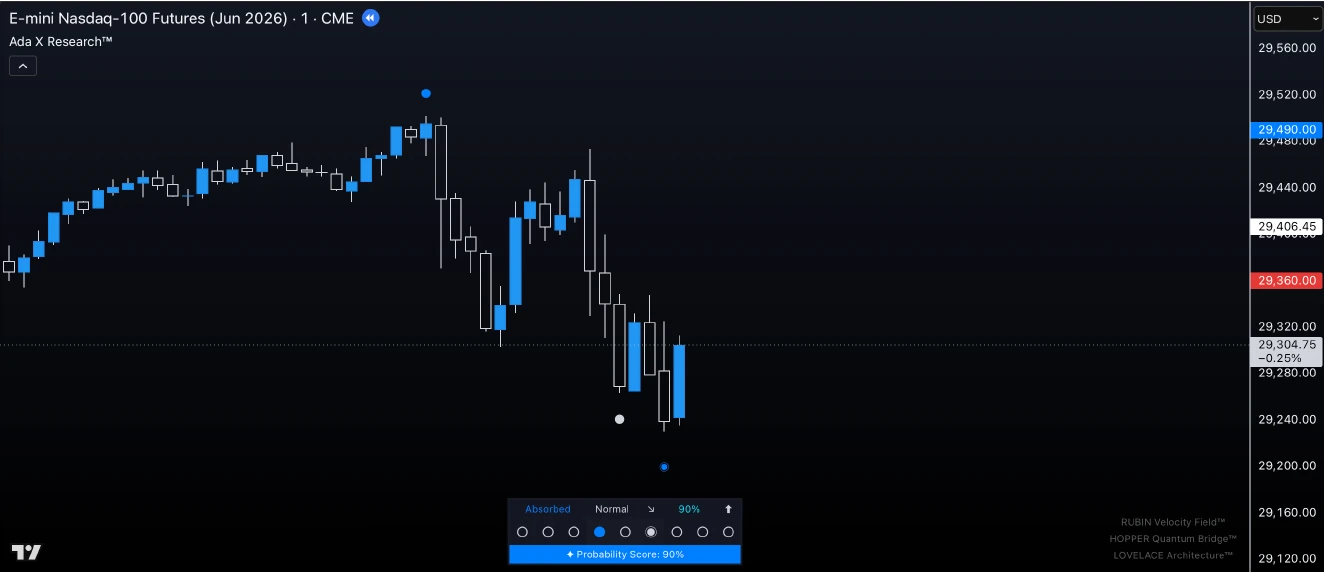
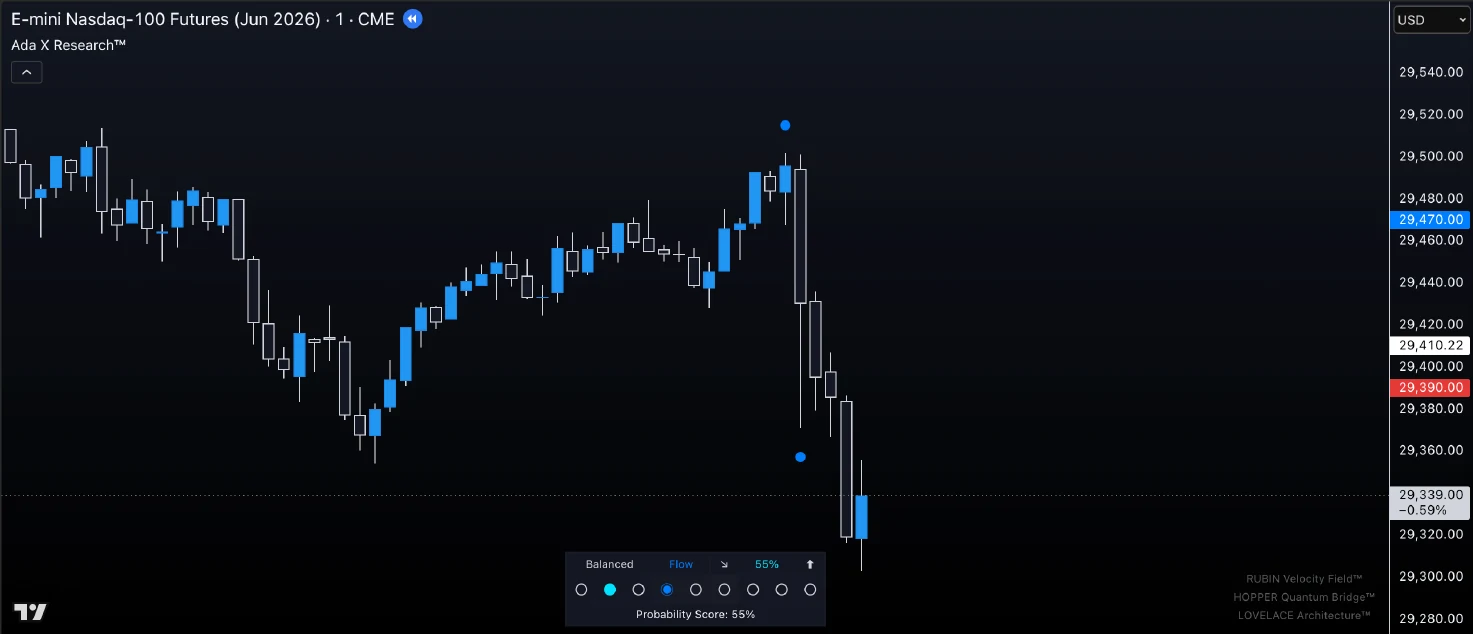
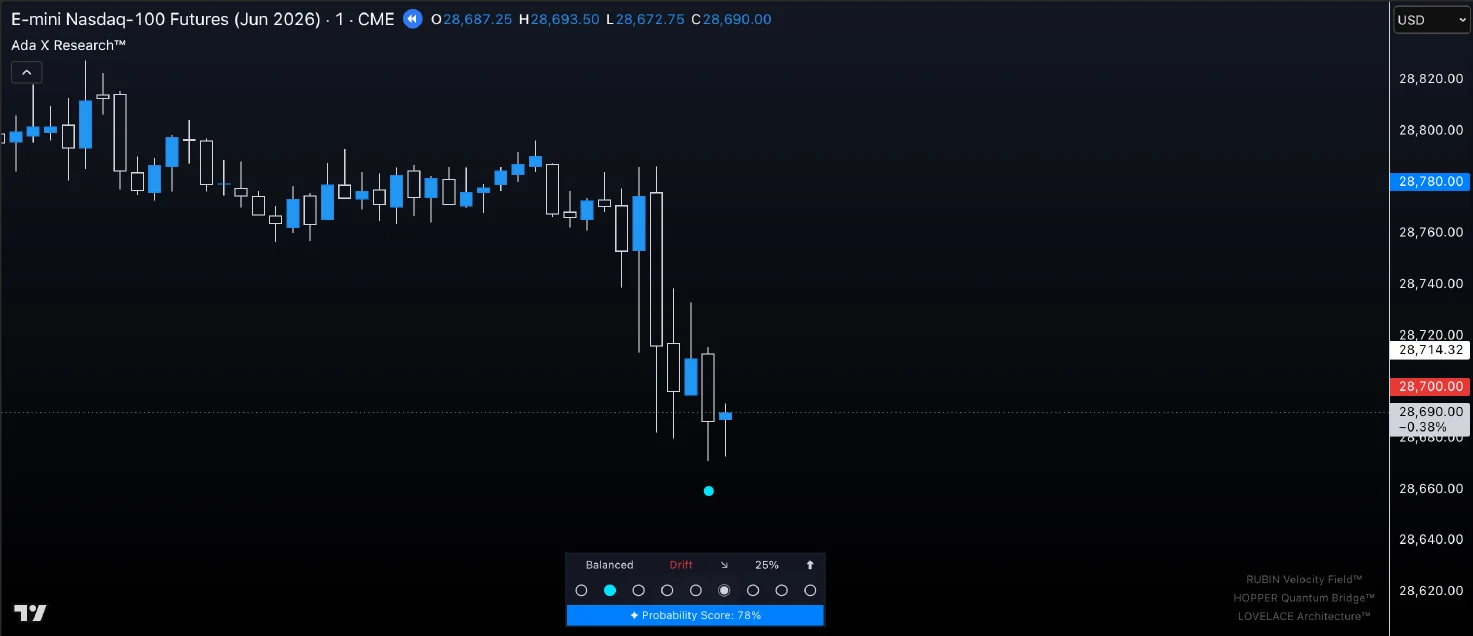
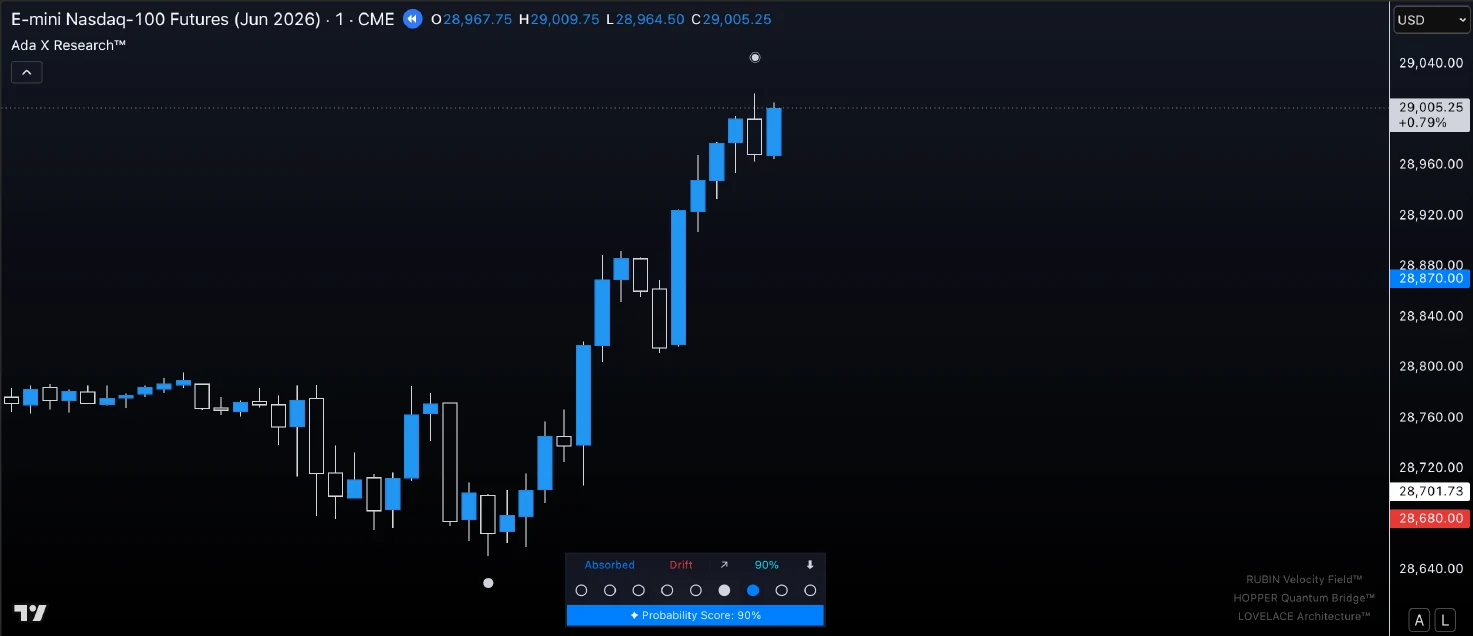
Recent field notes from Rubin and Hopper.
The latest research tiles collect live case studies across motion analysis, phase behavior, probability transfer, and auction response.
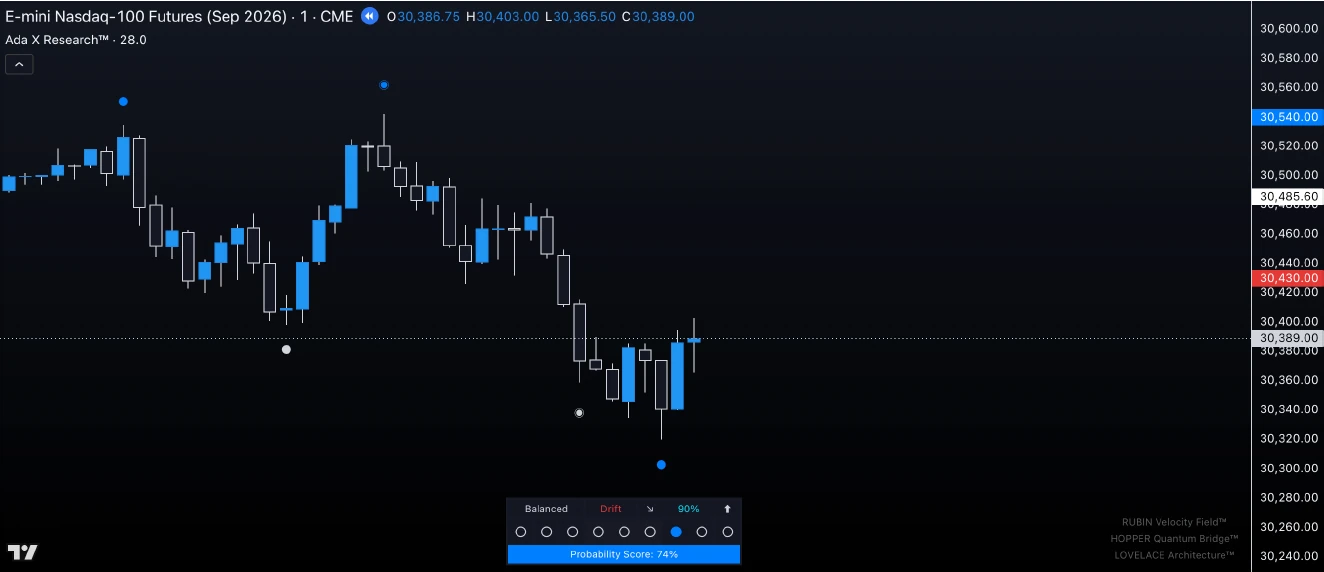
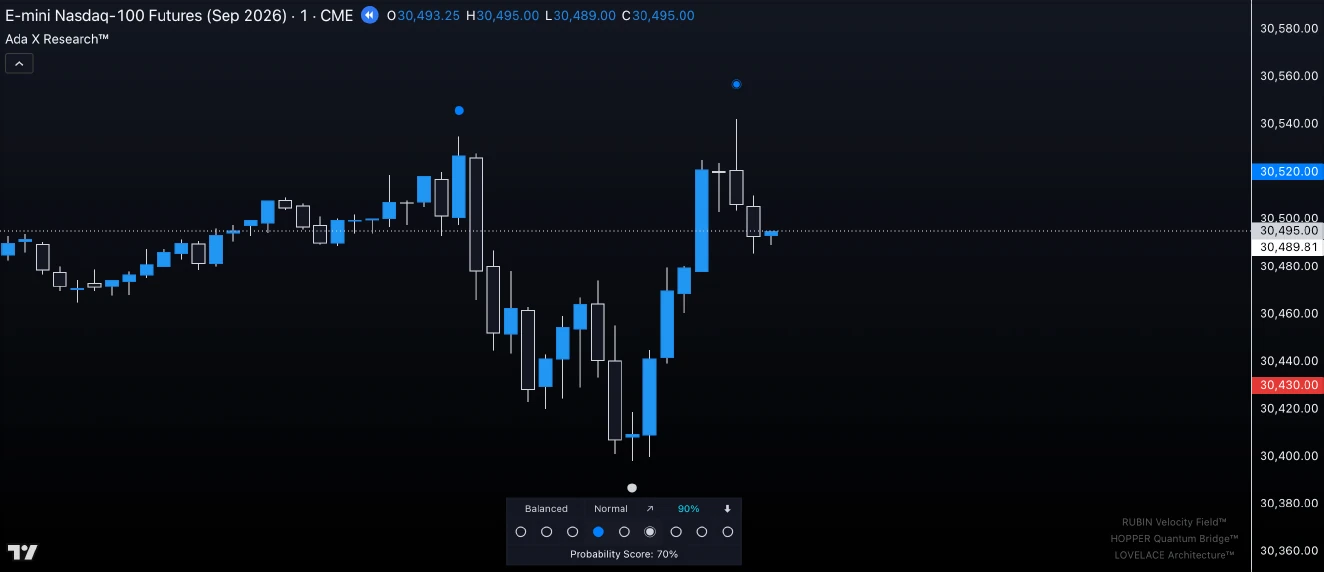
The trader needs the state, not the source code of the state.
The architecture handles the combinatorics. The interface shows the conclusion. More information is not always better; in live markets, too much data becomes cognitive drag.
Emotion is a model risk.
Fear exits too early. Greed overstays the move. Bias bends perception until traders begin seeing what they want instead of what is happening.
Protected methodology. Clear surface.
Ada X is designed to anchor decision-making in structured probabilities and observable behavior while keeping the underlying mechanics private.
Choose the depth of access that matches the research path.
Ada X editions organize access across the model stack, from foundational probability architecture to the full flagship research environment.

Pioneer Edition
Access to the Ada Experience Research environment with Ada, Grace and Rubin models.
View access
Quantum Edition
Full access to the advanced flagship models, future research models, and Ada X Companion.
View access
The Research Edition
Limited lifetime access for the full flagship models, future research models, and Ada X Companion.
View accessGet the latest Ada X Research news.
Join the email list for field notes, research updates, product access notes, and release announcements.
Research and software architecture material only. Nothing on this site is financial advice, investment advice, or a promise of performance.