Balanced Drift Follow-Up Before Upside Rotation
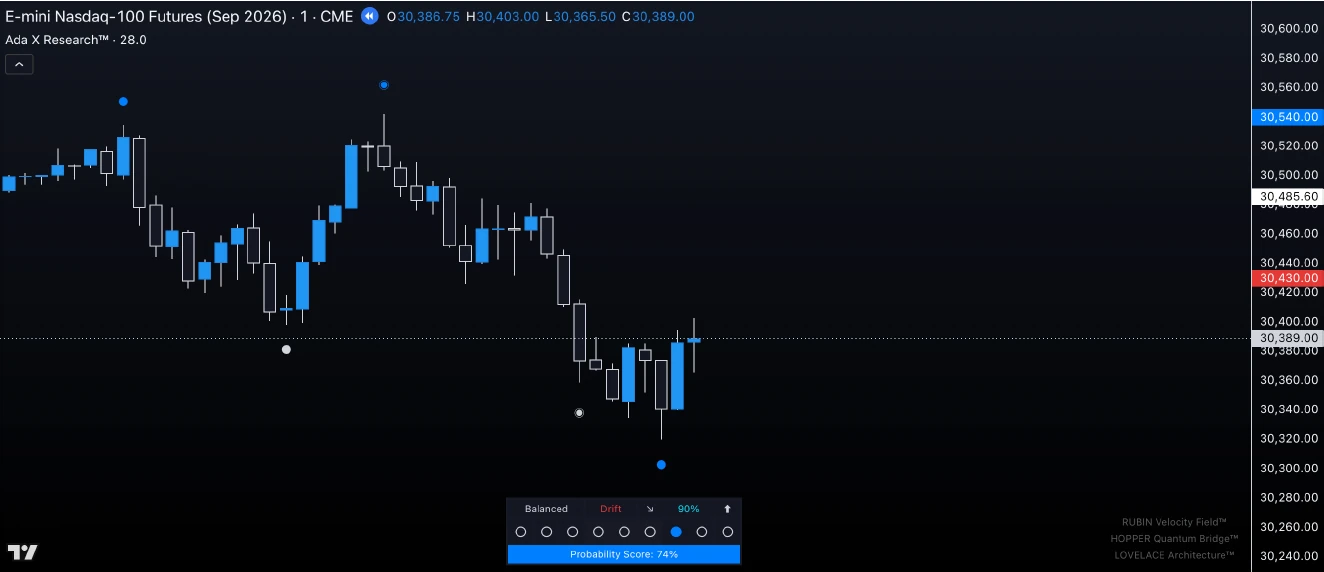
Our next case shows one movement ending and another beginning as Rubin reads balanced drift with Grace pointing to a 90% upside attack candidate.
The Follow-Up Condition
Case 10 follows directly from the idea that as one movement ends, another may begin. Rubin reads participation as balanced while motion is drifting to the downside, meaning the velocity of the prior move is slowing rather than expanding cleanly.
Grace's predictive logic identifies a 90% upside attack candidate. That creates a useful research contrast: downside movement is still visible, but the layered model is studying whether slowing velocity and low-state location are preparing the next upside rotation.
Why Drift Changes The Question
Drift is not the same as strong directional pressure. In Rubin, it suggests that motion is losing force relative to the prior sequence. When the chart is also sitting in a low state, drift can help separate late continuation from a possible transition in auction behavior.
The note uses that distinction carefully. The 90% Grace read is a strong foundation, but it is not treated as certainty. The before-frame asks whether the system has enough alignment between slowed downside velocity, balanced participation, and low-state positioning to study an upside response.
How The Market Resolved
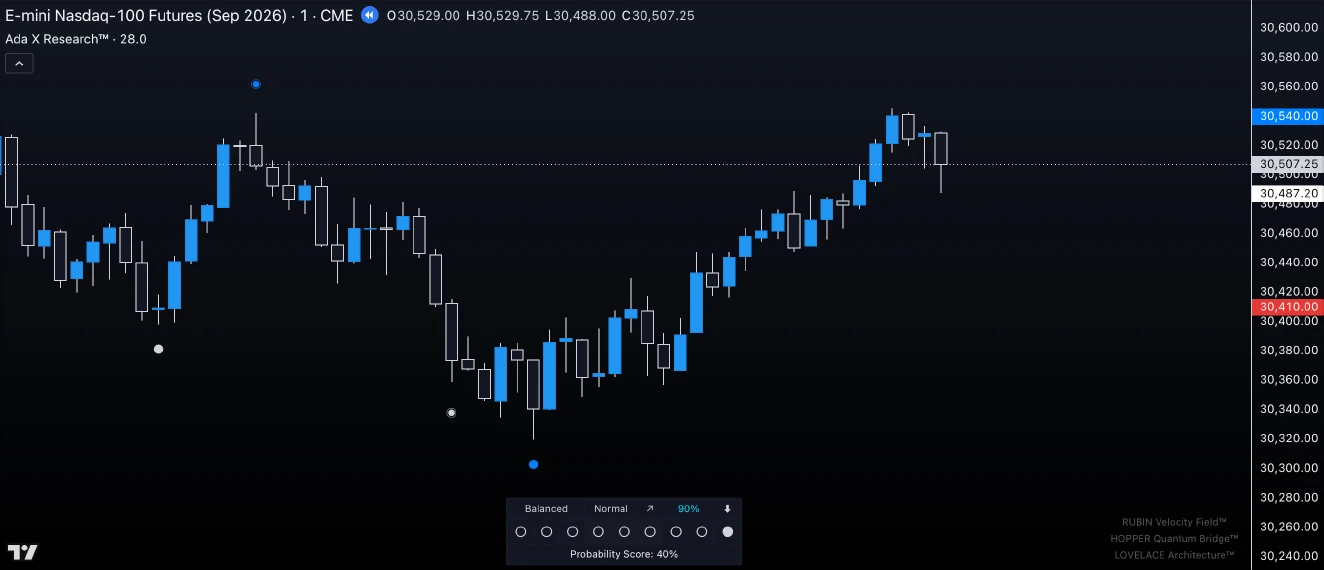
The after screenshot shows sufficient upward delivery. Participation and motion return to normal levels, and Grace rotates toward a 90% downside attack read. That rotation indicates that once the upside movement has matured, the next research condition may already be forming in the opposite direction.
Price also travels to a high value state, which can be a sign that the move has reached a mature area. Case 10 is therefore useful as a transition study: it shows a previous movement slowing, an upside candidate forming, delivery occurring, and then the field changing again after the response.
Screenshot Sequence
Study the next state with Ada X Research.
Disclaimer: Ada X Research is for educational and research purposes only. Nothing shared is financial advice, investment advice, or a trading signal. Trading involves risk, and users are responsible for their own decisions.
Request access